

Erald started practicing martial arts at the age of 7 with Karate Shotokan. Then discovered traditional Kung fu in 2000 at the age of 12.
Guided by Master Ignazio Cuturello in the first years, and then by Master Giuseppe Ghezzi for the rest of his career and until nowadays, both M^Cuturello and M^Ghezzi are direct pupils of Grand Master Chang Dsu Yao who founded the school of traditional Kung Fu in 1975 in Italy. Erald also holds a University degree in Philosophy and History Achieved in 2014. Erald is a former italian champion of traditional chinese martial arts, winning 2 major contests in his specialities. Traditional shaolin forms, and Thai chi chuan.
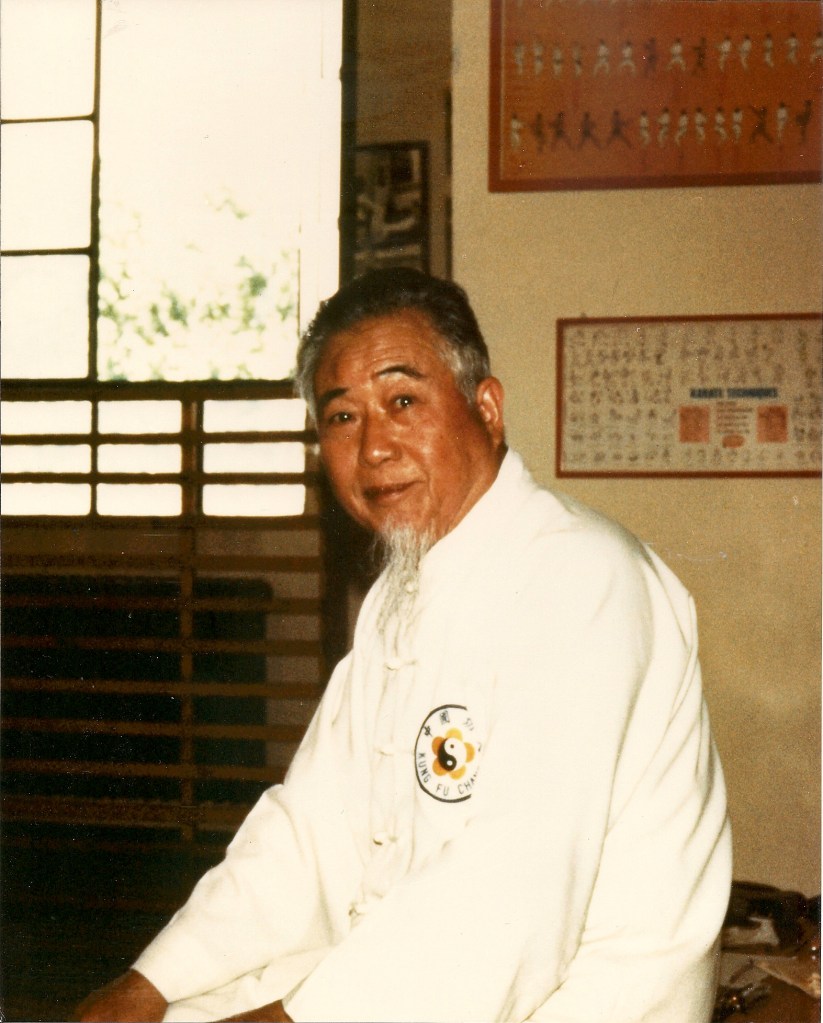
Chang Dsu Yao was born on June 14, 1918 in Chaiji (Chinese: 柴集村), a village in Zhuzhai district [zh] of Pei County, Jiangsu. He died in Taipei, Taiwan, on February 7, 1992. He was the sixteenth generation lineage holder of Meihuaquan.
He began to study Meihuaquan when he was six years old, and later trained under Liu Baojun.[1]
In 1938, he came to Guilin to study at the Military School for Officers,[2] a branch of Whampoa Military Academy created in that Year, named “Military Sixth Campus” (Chinese: 軍校第六分校; Wade–Giles: Chün-hsiao Ti-liou Fên-hsiao)). Here, Chang met some important teachers, such as Chang Dongsheng, and studied different styles of Martial Arts, such as bajiquan, baguazhang, xingyiquan, and Fu Style Baguazhang.[3] After graduation, he fought in the anti-Japanese War first and then in the Chinese Civil War with the faction of Chiang Kai-shek against the Communists.
After the defeat of Chiang Kai-shek, Chang Dsu Yao took refuge in Taiwan. In Taiwan he established contact with several famous Martial Artists such as Cheng Man-ch’ing, Liu Yunqiao, Wu Tipang (吳體胖), and Zhang Wuchen [zh]. He also taught Martial Arts to the Army and Police.[4] Chang wrote articles for “Wutan Tsa Chih”, a magazine founded by Liu Yunqiao.
In 1974, Chang Dsu Yao retired from the Army and in 1975, he moved to Bologna, and then, in 1977, to Milan. He had many students, including his sons Chang Wei-hsin and Chang Yu-hsin, and others, such as Xu Wenli, Giuseppe Ghezzi, Ignazio Cuturello, Maurizio Zanetti, Enrico Lazzerini, and Roberto Fassi, with whom he wrote several books on martial arts.
From Wikipedia
 Wushu Shaolin Dragons